
“With great power comes great responsibility”
ABSTRACT
Justice is the base of all civilized societies try to maintain the balance and fair treatment. The first mission of the criminal justice system is to give speedy reply, because longer time periods usually impugn the principles of justice. Internal issues like embedded prejudices, financial constraints and political pressure can undermine and sometimes outweigh efforts to achieve justice making it harder for people to close the gap of distrust and fix the inequity. This impacts especially marginalized groups who also face heightened discriminations and limitations who can access legal representation, turning the tribunals in to tools of oppression instead to justice. The aim of the courts is that of the safeguarding of human dignity and the guarantee that legal procedures are employed for the promotion not for the hinderance of justice. An equitable trial is based on values of integrity, transparency and the inherent dignity of every person. Yet these values can be often diluted due to institutional dysfunctions, causing unjust treatment, wrongful conviction or violation of elementary rights. In order to meet these issues the legal system needs to respect human rights and do that trials are added and equal. This involves carrying out systemic reforms including the incorporation of technological tools, strengthening judicial human resources and pushing for alternative dispute resolution mechanisms. Therefore, the system would be better placed to distribute justice fairly and speedily to all. The long-term goal is to have public trust in the court re-established by resistant to the law through up-regulated administrations of justice. By fulfilling these objectives, the administration of justice can meet its core function of providing fair and impartial justice for all people.
INTRODUCTION
Justice functions as the foundation and the aim of all civilized nation or society. Over time, people have always had faith that justice would ultimately prevail. The management of social and legal entities is a constitutional duty. Human rights issues as they occur during trials bring to light broader social issues related to equality, justice and fairness and, therefore, carry significant weight. A fair trial is built on truth, openness, and dignity of every human being. However, these objectives frequently fail because of internalised biases, lack of funding, cultural and political factors.
Marginalised people may face additional barriers to access to justice based on their race, class, sex or other characteristics, including lack of awareness of legal processes and the lack of access to legal representation. When people are vindictively penalised for who they are, their identities, trials become forms of oppression. The main function of the prosecution is to keep the community safe from criminal and criminals. Inmates are possible to rehabilitate only to some extent with efforts of reformative therapy interventions. A good criminal justice system is required by every community in order to live sustainably peaceful life.
EXPEDITIOUS TRIAL
The main aim of the criminal assize of justice is the swift clearing of criminal offenses, because every delay of this would amount to erosion of the majesty of justice. For that reason, it has been correctly stated that the administration of prompt justice is an essential constituent of an ordered society. As the saying goes: justice hurried is justice Birdied ; meaning the issue must be resolved quickly along with the key elements that define a fair society. The principle purpose of any legal system is to afford justice to all citizens in a harmonious manner and therefore principle and practicality of the legal system as a whole must strike a balance in the judicature.[1]
“Sheela Barse v. Union of India”[2]
The Hon’ble Apex Court has held that prolonged delays in the case of a defendant before the Magistrate’s or Sessions Court at the hands of the defendant would be violation of the basic right of the defendant to get a speedy trial. This is irrespective by way of whether an interim keeping from a bore court reasonably ends in a take a obtain or if the wrongdoing resorts delay of any sort in the case. If Hamas prosecution offends the right to a speedy trial, it may be dropped.
“P. Ramachandra Rao v. State of Karnataka”[3]
The Hon’ble Supreme Court opines that the government has inherent duty to deliver speedy justice, mainly in criminal cases. The paucity of resources cannot be used as to demean the individuals of their constitutional right to justice as enshrined in Article 21, 19, and 14, the preamble, and the directive principles of state policy.
CHARACTERISTICS OF DELAY AND TIMEFRAME
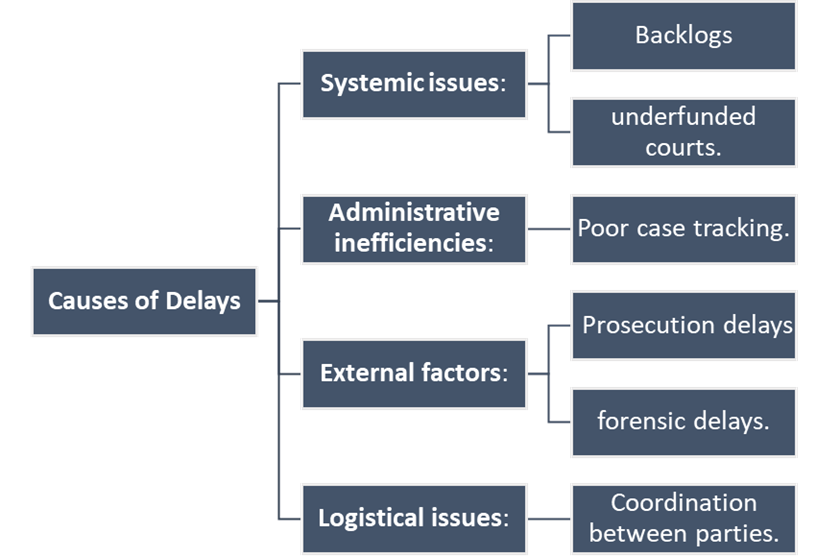
The defendant or the prosecution will likely have no control whatsoever over the factors which cause delays in criminal proceedings to continue. The courts operate behind schedule thereby menancing to be unavailable to access. Prolonged backlogs in case resolution may develop if courts get less time to dispose of cases for the reason that there are a lot of unsolved problems.[4] However, the cause of these delays cannot be put entirely with one person. The prosecution then needs to take action to identify a stimulating witness, evade legal proceedings, keep track of vital proof, or obtain documentation over seas, a course of procede that may take numerous months.[5]
Systemic delays can occur within legal system when infrastructure or processes of legal system are insufficient. Delayed developments add to the pace of cases including inadequate court personnel, old legal case management software and insufficient budget for the bodies who are on teams cases tanks.[6] The resolution of these cases might need more time that it is supposed to when there is a poor coordination between different bodies of the court such as prosecutors, forensic laboratories and the law enforcement agencies. Poor case filing and tracking system may lead to prolonged wait times. Courts may allow for continuations causing delays in some cases. Sure, such delay would come out of administrative restrictions or logistical issues. Long waits may result from inefficient co-ordination in arranging the attendance of all parties concerned, such as the accused, witnesses, and legal representatives for all.[7]
JUST TRIAL
Achieving justice always necessitates trials. Following each step is necessary to ensure that trials remain fair and unbiased. A fair trial means a fair trial for everybody, not just a impartial judge, but so that all parties get a fair trial, that the procedures are public. The right to fair trial is essential safeguard for administration of justice thereby providing the basic assurance to the human rights and rule of law. Opportunities to prove innocence ought to be granted in integrity and also in equity under the law.[8]
“Zahira Habibullah Sheikh and others. v. State of Gujarat and Others”[9]
The Supreme Court of India has observed that all individuals are entitled to a basic right for fair treatment in the criminal courts. Denial of fair trial also leads to the infringement of the right to justice that can lead to the deprivation of justice to the accused, the victims and society as a whole. Justice should wherever possible be meted out from an impartial court using an impartial prosecutor and a calm judge.
FAIR & EQUITABLE TRIAL
In adversary trials, both sides present to an impartial competent judge. This suggests a fair unbiased procedure of a court.[10] 3 critical elements of any trial- fair-mindedness of the judge, fairness and impartiality in the assessment of evidence, protection of rights of the prosecution and the defence. This framework confers credibility to the judicial system. It lays the groundwork of justice by equilibrating the potency dynamic in between people and the government. A distinctive feature of adversarial judicial systems is the rule against double jeopardy, which forecloses the possibility that a particular individual will be prosecutable or punishable two or more times for the same alleged criminal act. The concepts of autrefois acquit and autrefois convict also thus show that judgements are final. Another defense, autrefois acquit, shields a person against subsequent trial, following acquittal. A new defence, already convicted of it will bar future prosecution in case of conviction.[11]
The presumption of innocence is a cornerstone of the fair trial and is essential to adversarial disputing processes. It lays down a duty on the prosecution to prove the defendant’s guilt beyond reasonable doubt. All four parts are needed in order for the adversarial process to be regarded as fair. The system guards individual rights and ensures justice by mutual respect for fair adjudication, the protection against double jeopardy and the principle of the presumption of innocence in the course of legal proceedings. This protection is necessary for people to have faith in the courts.[12]
THE PRINCIPLE OF FAIR TRIAL IN INTERNATIONAL LAW
The idea of a fair trial-system globally accepted nowadays, is originated from international law. The municipal laws of the signing parties had to be adapted to include provisions of the accords.[13]
“Article 10 of the Universal Declaration of Human Rights” States that “Everyone is entitled in full equality to a fair and public hearing by an independent and impartial tribunal established by law.
As well as “Article 11(1)” states that innocent is ascribed to a suspect, unless proven guilty. The only way for a person to be found guilty is with a public trial where he has a right to be heard in his defense.
Article 11(2) states that no one shall be penalised for an act which did not constitute a criminal deception when it was committed, so preventing the retrospective application of legislation later established to be criminal. Moreover, the punishment should not be greater than the notoriety that the individual may have involved at the time of engaging the misconduct.
Article 14(1) of International Covenant on Civil and Political Rights states, “Allare equal before the courts and tribunals.”
RIGHT TO A FAIR TRIAL AND THE INDIAN CONSTITUTION.
The Indian Constitution is supreme in Indian legal system. In consequence, it forms the basis of construction of the criminal justice system.
Article 20(1) prohibits the making of retrospective laws. No one shall be punished for an act not considered criminal under the law in force at the time of its execution, at least when the international law in question had not as a consequence reported after that time. No punishment should exceed what was deserved at the time the criminal behavior occurred.
Article 20(2) sets prohibition of double jeopardy.
No one shall be required to provide evidence of this nature which might be used to incriminate him further, foregoing Article 20(3).
In accordance with Article 22(1), information about the rights of the individual including the right to legal representation and to bail must be given to the individual pertinent to arrest and detention.
Following Article 22(2), an individual is to be produced before the nearest Magistrate from within twenty-four hours after the individual has been taken into custody. The state has to supply a lawyer to any one who can’t purchase it pursuant to Article 39.
BHARATIYA NAGARIK SURAKSHA SANHITA (BNSS), 2023 AND FAIR TRIAL
By Section 308: Any article or material which it is contemplated will be required as evidence in a trial or in any proceedings preliminary thereto shall be given to the accused in his presence.
Under Section 313, every witness has to have their evidence read in to the accused or his legal representatives. If the language of the evidence is unintelligible to the accused then it must be translated for him on so as for him to understand to be presented to a judge and jurors.
As per Section 316, a magistrate has to dictate to the accused in intelligible language, the substance of his examination and to reduce it, and get his signature.
Again under Section 337, no person can be subjected to a second trial for the same of defence that he had already been acquitted and convicted of by a court with a competent jurisdiction.
A person can represent him/herself with their selected lawyer under Section 340 in a criminal court where charged for crime.
the state is required by Section 341 to provide free legal assistance if that defendant does not have the resources to obtain private counsel.
The court may examine the accused, in accordance with § 351; the accused does not have to take an oath in that case.
United States Legislation and Human Rights Concerns in Judicial Proceedings
An analysis of human rights matters in criminal cases of India and the United States brings to surface similarities and considerable differences in the safeguard of rights within the trials of each country.[14] In all legal tradition the fact that a man is not guilty is presumed. Still, however, the problem of trials being delayed is an age-old issue in both the countries where in India mostly they refer to case backlog due to a congested judicial system. By contrast, when the US faces delays it authorizes additional resources to accelerate the trials; and yet structural inequalities prevail, particularly in poorer areas.
An important distinction is in the entitlement to attorney representation. In the US the right to legal representation is securely set in place, with public defenders being available to everyone unable to pay for a private lawyer. India provides legal aid but the availability of good lawyers may suffer, especially for economically disadvantaged individuals. In addition to this, the United States has problems of racial discrimination and consequent disproportionate sanctioning of minorities as well as insufficient legal representation.[15] In India, caste police and polic violence against Dutchmen threaten the fairness of the procedure. These mechanisms must balance out the situation in order to achieve human rights in criminal proceedings.[16]
Legal Framework and Human Rights Concerns in Judicial Proceedings in the United Kingdom
Both countries use adversarial systems in which case the prosecution and the defence argue their cases in front of an unpartisan judge. Both countries have the concept of the presumption of Innocence which implies an accused is deemed to be innocent until proven guilty. Systemic delays and backlogs plague the operation of both legal systems but generally the UK runs to a more modern and efficient system of case management thereby latter delays in India.[17]
The biggest difference is throughout the entire legal aid system. UK law provides greater access to legal aid and on the basis that (unlike the US) residents are paid a publicly funded lawyer if they are unable to afford a privately retained lawyer. In India, despite the existence of legal aid, the quality of legal representation is uneven and many defendants are prevented from receiving effective legal assistance although particularly rural areas.[18] The uk’s judiciary has always respected the right to a fair trial and has a set of robust protections against the torture or maltreatment of people in police custody. Even as India has assured safety, fears over police atrocities & deaths in custody still persist in some parts. Both legal systems must continually be reinforced to address the human rights problems and provide fair disposal of amount of people.[19]
CONCLUSION
This paper clarifies which human rights concerns are related to criminal trials and how important these rights are for the justice of trial and its integrity. Studies show that systematic delays, inadequate legal representation, and other prejudices remain common problems in various criminal justice systems, all around the world, such as India, the USA and the UK. In India, problems like Backlog of cases, unequal access to legal aid and Police brutality has not only exposed the most vulnerable to injustice but also weakened the integrity of trials. In the United States even though legal aid is available, racial bias and unequal sentencing continue to be a major human rights problem. Though obstacles to justice in the UK are relatively minimal, prejudice continues to be a major problem within the criminal justice.
This paper underlines the magnitude of the changes needed to address these issues including access to good quality legal advice, reducing trial delays and assured equal treatment for all regardless of race, caste or economic status. By deriving lessons from numerous countries and putting emphasis on systemic improvements, one can build up the protection of human rights within the criminal justice system and create a more just, transparent and likewise fair global Judiciary.
[1] “Requirement Of Expeditious Trial Must Be Read Into Special Statutes Imposing Stringent Bail Provisions : Supreme Court,” available at: https://www.livelaw.in/top-stories/requirement-of-expeditious-trial-must-be-read-into-special-statutes-imposing-stringent-bail-provisions-supreme-court-270769 (last visited March 14, 2025).
[2] 1986 SCC OnLine SC 205.
[3] 2001 SCC OnLine SC 691.
[4] “Criminal trial delays – An overview,” available at: https://timesofindia.indiatimes.com/readersblog/thelegalaudience/criminal-trial-delays-an-overview-44908/ (last visited March 14, 2025).
[5] “Judicial Delays In India: Causes, Consequences, And Possible Solutions » Lawful Legal,” available at: https://lawfullegal.in/judicial-delays-in-india-causes-consequences-and-possible-solutions/ (last visited March 14, 2025).
[6] “INDIAN JUDICIAL DELAYS AND CASE BACKLOGS. CREATIVE AND CRITICAL EVALUATION. BY – SOVI GEORGE & GEORGE KO,” available at: https://www.ijlra.com/paper-details.php?isuur=3617 (last visited March 14, 2025).
[7] “Judicial Delays in India: A Stumbling Block to Justice » LegalOnus,” available at: https://legalonus.com/judicial-delays-in-india-a-stumbling-block-to-justice/ (last visited March 14, 2025).
[8] “The right to a fair trial | Fair Trials | Fairness, equality, justice,” available at: https://www.fairtrials.org/the-right-to-a-fair-trial/ (last visited March 14, 2025).
[9] AIR 2006 SUPREME COURT 1367
[10] Carsten Momsen and Marco Willumat, Due Process and Fair Trial (Edward Elgar Publishing, 2024).
[11] “(PDF) The Paradigm of Fair Trial in Adversarial System: A Legal Discourse,” available at: https://www.researchgate.net/publication/370415049_The_Paradigm_of_Fair_Trial_in_Adversarial_System_A_Legal_Discourse (last visited March 14, 2025).
[12] Paul M. Taylor, “Article 14: Fair Trial Rights” A Commentary on the International Covenant on Civil and Political Rights 369–428 (2020).
[13] Fuad Zarbiyev, “Judicial Activism in International Law—A Conceptual Framework for Analysis,” 3 Journal of International Dispute Settlement 247–78 (2012).
[14] S. Shanthakumar, “Human Rights and Criminal Law: Navigating the Intersection of Justice and Liberty,” 2 Indian Journal of Law 26–31 (2024).
[15] Daniela Berti and Gilles Tarabout, “Introduction. Through the Lens of the Law: Court Cases and Social Issues in India,” 17 http://journals.openedition.org/samaj (2018).
[16] “Constitutionality of Media Trials in India: A Detailed Analysis – Academike,” available at: https://www.lawctopus.com/academike/media-trials-india/ (last visited March 14, 2025).
[17] “Organized Crime Module 9 Key Issues: Adversarial versus Inquisitorial Legal Systems,” available at: https://www.unodc.org/e4j/en/organized-crime/module-9/key-issues/adversarial-vs-inquisitorial-legal-systems.html (last visited March 14, 2025).
[18] Arushi Garg, “A Dynamic Theory of Prosecutorial Roles in Adversarial Trials,” 11 Asian Journal of Law and Society 152–77 (2024).
[19] “United Kingdom | European Judicial Network(EJN),” available at: https://www.ejn-crimjust.europa.eu/ejn2021/ContentDetail/EN/5/31 (last visited March 14, 2025).

Leave a Reply